|
| A cell's DNA takes a direct muon hit! |
Radiation coming from both the sky and the earth, in all its
forms, is a fact of life here on earth. Most of it is very
beneficial; we wouldn't be here were it not for the light and heat
coming from the sun. some of it, however, can be harmful. Ever since
humans (and all life forms for that matter) first evolved, we've
been bombarded by radiation, of one type or another, both from outer
space and from radioactive materials in the Earth itself. We've all
seen this solar electromagnetic spectrum chart (see below), that
depicts the wide range of energy that can affect us daily. Most of
the energy, including
the visible spectrum and everything to the left
are innocuous
at normal levels.
This is not the case for
energy of higher frequencies found on the left side of the visible
spectrum. Because they vibrate so much faster, they can ionize any
organic matter that they strike. Most people know that too much
exposure to UV-B waves can cause sunburns that, over a long period of
time, can result in some for of cancer for an unlucky few. We are
even more susceptible to X-Rays and Gamma rays, but thankfully, our
thick atmosphere filters most of these out before they can reach the
surface!
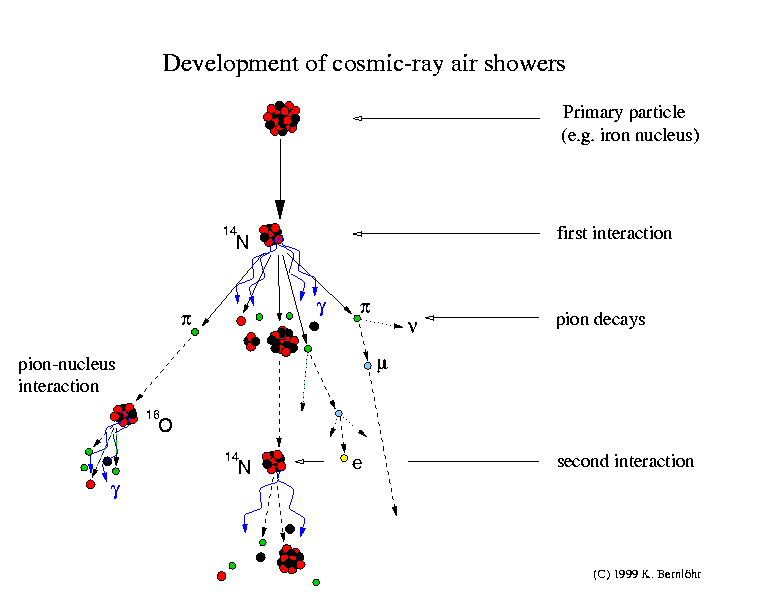
Were all that not enough, there are also the very harmful Cosmic particles
that come to our planet either from deep space or, more infrequently,
from mass corneal ejections of the sun. The majority (80%) of these
particles are single protons which are simply hydrogen atoms that have been
stripped of their electrons (although heavier nuclei like iron can
come blasting in). They are created when a star somewhere in this or
another galaxy goes nova and so ejects material at great velocities.
And, since these particles have mass and are traveling at close to
the speed of light, they can really pack a wallop if they hit a
living cell! (Thankfully, the magnetic field around the earth helps
to shield us from much of this nastiness). Of the cosmic rays that do
hit the atmosphere, most smash into air molecules (most often
nitrogen) and cause a billiard ball effect or 'air showers' of
secondary particles (see below).
 |
| The little blue spheres are the muons! |
Once again and thanks to the thickness of our atmosphere (35
miles), most of the cosmic rays never make it to the ground as their
energies are absorbed by the constant collisions with other air
molecules. How many do make it? On a surface of about the size of a
hand, approximately one secondary particle hits every second. And of
these, most are little nasties called muons which I like to think of
as fat electrons. While extremely light (just 200 x's more heavy than
an electron), muons can do a real number on a humans DNA over time
and constitute about a third of the ionizing radiation our bodies
have to deal with. [Note: The closer you live to sea level, the
better. People living in mountainous areas like Denver Colorado
receive over 300% more of these bad guys that those of us living lower
down, like say Chicago...Sure hope the view there is worth it]!
The good news, in all this, is that we've been living with
radiation ever since life evolved and have long ago developed repair
mechanisms that mediate most all of the damage. Radiation dosages are
often measured in
Sieverts
with a dose of one Sievert per year responsible for about a 5.5%
increase in the rate of cancer. Here, where I live in Forsyth
Missouri, the background levels of radiation are actually quite low –
about .11 uSv/h (micro Sieverts per hour). That's a tenth of a
thousandths of a Sievert per hour, or put another way it would take a level of
114.1 μSv/h every day for a whole year to equal a dose of just 1 Sievert! Now that's a
background level of radiation I can live with!

 For many years I frequented a couple of bars
that satisfied a couple of my needs; 1) they were close by and 2)
they served beer! Now, even though I grumbled from time to time about
the prices, I still enjoyed the social interaction that only a bar
can offer to an old bachelor...
For many years I frequented a couple of bars
that satisfied a couple of my needs; 1) they were close by and 2)
they served beer! Now, even though I grumbled from time to time about
the prices, I still enjoyed the social interaction that only a bar
can offer to an old bachelor...